

Yes, an electric toothbrush can damage teeth and gums, but only when combined with excessive brushing pressure (forces above 2.9 Newtons) or highly abrasive toothpaste.
When used properly with soft bristles and gentle guidance, an electric toothbrush is statistically safer and removes up to 21% more plaque than a manual toothbrush, significantly reducing long-term enamel wear.
The good news is that with the right technique and the right products, using an electric toothbrush is one of the smartest things you can do for your dental health. Millions of people use them every day without any issues.
This clinical guide details the safe operation of motorized dental tools:
-
How do oscillating and sonic mechanisms affect tooth enamel?
-
What is the exact force threshold that triggers gum recession?
-
Which toothpaste abrasivity (RDA) levels are safe for electric brushes?
-
How do built-in pressure sensors prevent mechanical wear?
Key Takeaways
-
Electric toothbrushes can cause wear, but only when combined with too much pressure, abrasive toothpaste, or already-weakened enamel. The motor itself is not the problem.
-
Modern electric toothbrushes are generally safe when used at a gentle pressure with soft bristles. Most users naturally apply less force with an electric brush than with a manual toothbrush.
-
The main risk comes from brushing too hard for too long. Forces above roughly 2.9 N can lead to gum recession and notching at the gumline over time.
-
Lab studies show electric brushes can cause more dentin wear than manual ones under identical conditions, but real-world users typically brush more gently with electric brushes.
-
The smartest move is not to stop using your electric toothbrush. It is to refine your technique and pair it with enamel-supportive products.
Why People Worry Electric Toothbrushes May Be Damaging Their Teeth
You switched to an electric toothbrush because you wanted to do right by your teeth. Then your dentist mentioned some recession, or you noticed a new sensitivity to cold water. It's natural to wonder: did my toothbrush cause this?
We know this can be frustrating. Over 130 million Americans now use electric toothbrushes, and as their popularity has grown, so have questions about whether they might be doing more harm than good. Social media anecdotes, bold marketing claims about deep cleaning power, and the intensity of a sonic brush vibrating against your teeth can make anyone second-guess their routine.
Here is the thing. Most enamel and gum issues develop slowly over months or years. The electric toothbrush can feel like the obvious suspect because it is the newest and most powerful tool in your mouth. But the reality is usually more complicated. Someone who switched to a new brush in 2022 and now notices sensitivity with cold water may be noticing pre-existing enamel weakness that the brush revealed, not caused.
Quick Answer: Can Electric Toothbrushes Damage Teeth or Enamel?
Yes, electric toothbrushes damaging teeth is a real possibility, but it is about how you use the brush, not the technology inside it.
Enamel is the hardest tissue in your body. But once it is worn or scratched, it cannot biologically grow back.
According to the American Dental Association's 2024 Oral Health Guidelines, actively protecting existing enamel from mechanical abrasion is the most critical factor in preventing long-term structural decay.
The science from 2017 through 2025 tells a nuanced story. Under identical lab conditions with the same force and toothpaste, electric toothbrushes, especially sonic toothbrushes, can cause more tooth surface loss than manual toothbrushes. However, real-world users typically apply less force when brushing with an electric toothbrush, which makes them safer in practice for most people.
The SNOW Electric Toothbrush is designed to make safe, effective brushing simple. It features soft bristles that are gentle on teeth and gums, a built-in two-minute timer, and a pressure sensor to help you avoid overbrushing. It is a great fit for anyone who wants a deeper clean without the worry.
Upgrade Your Brushing Routine with the SNOW Electric Toothbrush
How Electric Toothbrushes Actually Work (And Why They Feel “Stronger”)
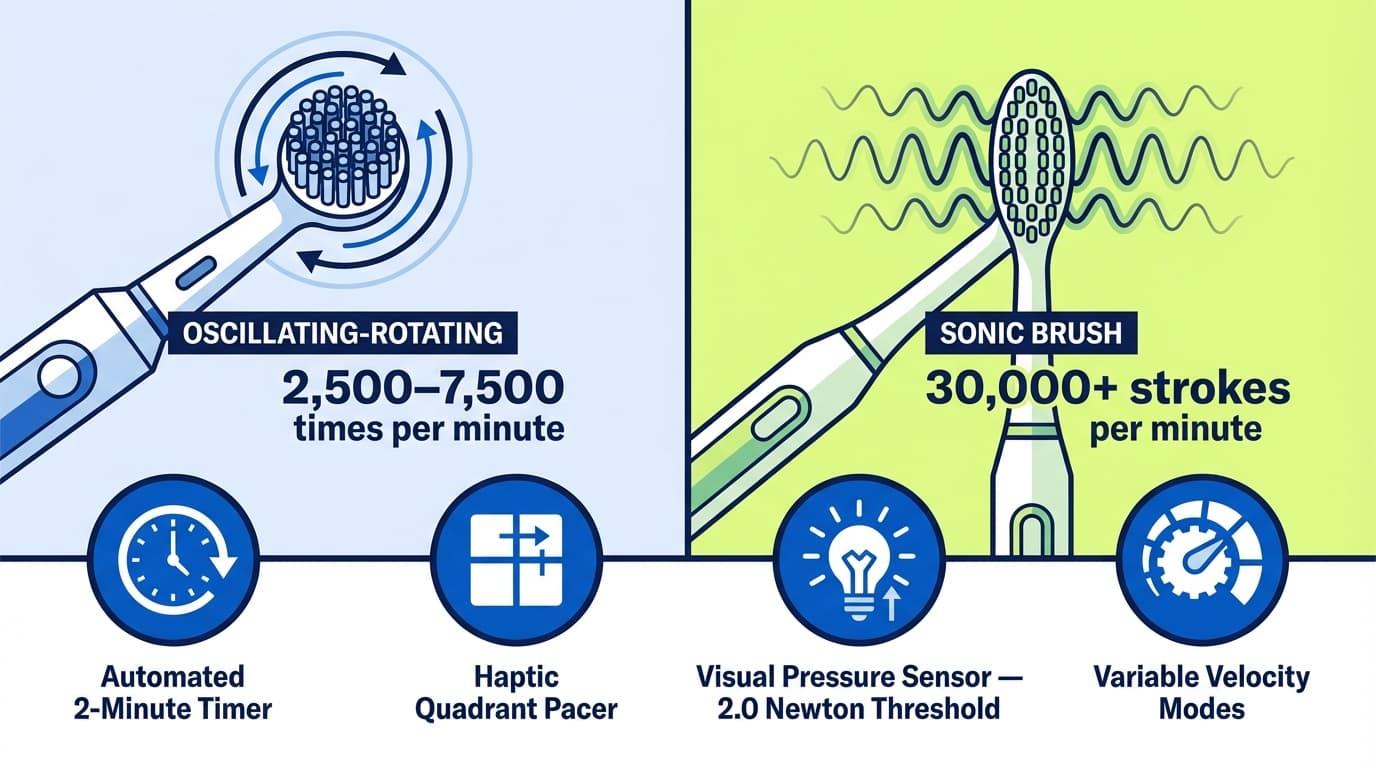
Electric toothbrushes remove plaque through a rapid, repetitive motion that your hand simply cannot match. That efficiency is why they feel more intense, and why many electric toothbrushes consistently outperform manual toothbrushes at removing plaque.
The Plaque Removal Efficacy of Oscillating-Rotating Brush Heads
These use a small, round brush head that pivots or rotates, often with added pulsation. The rotating bristles typically move between 2,500 and 7,500 times per minute. Research published in the Cochrane Database confirms that oscillating models remove more plaque than manual brushing in the short term.
Fluid Dynamics and High-Frequency Cleaning in Sonic Toothbrushes
Sonic technology uses a longer, oval-shaped brush head that vibrates at high frequency, often 30,000 or more strokes per minute. This rapid movement creates fluid dynamics around the teeth, cleaning through both direct bristle contact and the fluid motion it generates in your mouth.
Built-in features that protect you
Modern electric toothbrushes utilize integrated hardware features to enforce safe brushing mechanics:
-
Automated 2-Minute Timers: Prevents cumulative enamel wear by ensuring users do not exceed the clinically recommended brushing duration.
-
Haptic Quadrant Pacers: Vibrational alerts that signal the user to change zones every 30 seconds, preventing localized over-brushing.
-
Visual Pressure Sensors: LED indicators and motor-throttling mechanisms that activate the moment brushing force exceeds the safe 2.0 Newton threshold.
-
Variable Velocity Modes: Adjustable motor settings that allow users to lower the oscillation speed for sensitive gums or post-surgical oral care.
A 2025 narrative review in BMC Oral Health found that pressure-detecting mechanisms can reduce tissue damage within about six weeks of regular use, essentially training users to apply gentle pressure without thinking about it.
What Does the Science Say About Electric Toothbrush Damage?
The last decade has produced solid data on how different brush types affect tooth wear. Here is what the evidence suggests.
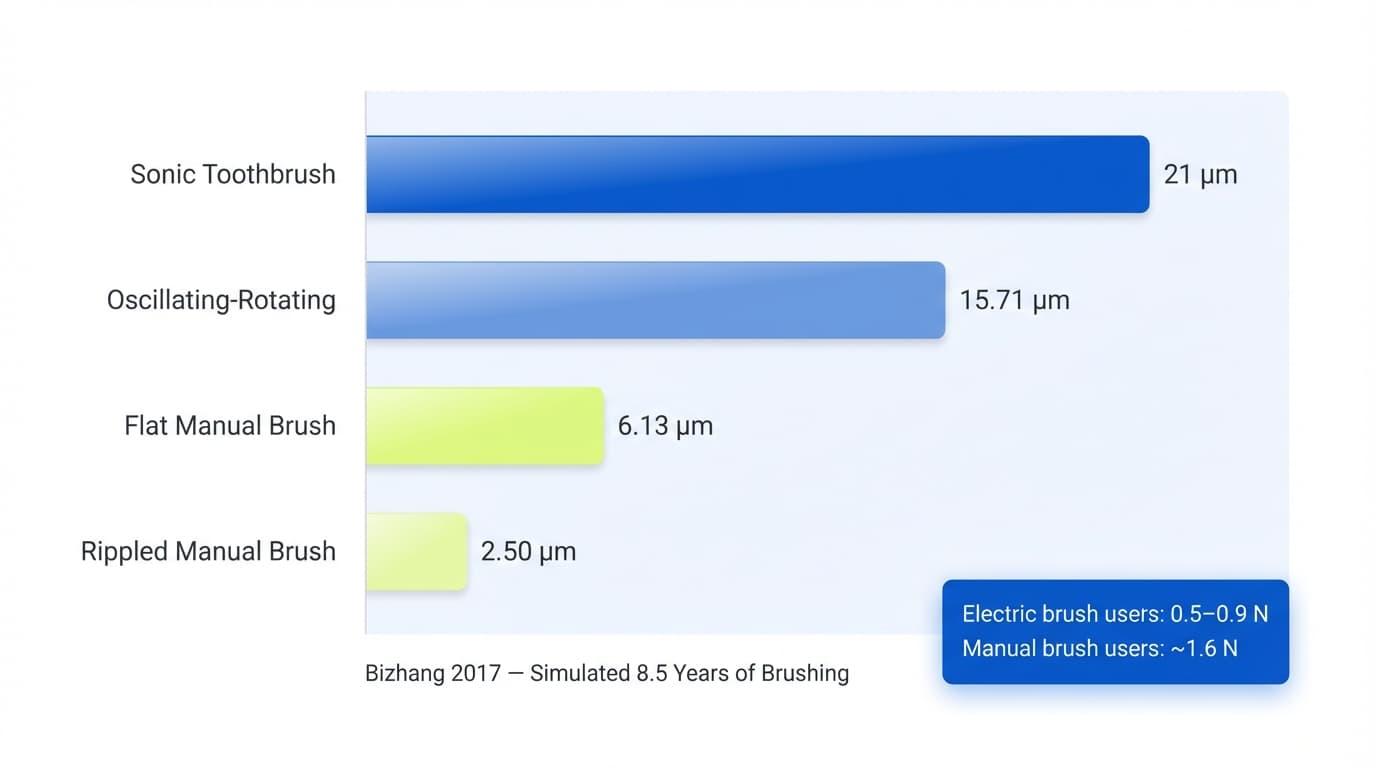
The Bizhang 2017 study simulated 8.5 years of brushing under identical conditions and found:
-
Sonic toothbrushes: approximately 21 micrometers of tooth surface loss
-
Oscillating-rotating brushes: approximately 15.71 micrometers
-
Flat manual toothbrush: approximately 6.13 micrometers
-
Rippled manual brush: approximately 2.50 micrometers
A 2025 in vitro study from PMC confirmed that two sonic brush models caused greater dentin abrasion than the ADA reference manual brush at the same load. The study found that toothbrush type, not bristle coating or other variables, was the primary driver of wear.
Here is the important context, though. These are lab studies using standardized forces that do not always reflect how people actually brush at home.
The Kumar and Gopalkrishna 2025 narrative review, which analyzed 118 studies spanning 1967 to 2024, concluded that when used at gentle forces at or below 2 N with pressure-sensing feedback, electric toothbrushes are generally safe and remove more plaque with less user effort.
The reason for the difference between lab and real-world findings is straightforward:
-
Electric toothbrush users typically apply 0.5 to 0.9 N of force
-
Manual toothbrush users typically apply around 1.6 N of force
The brush does the work, so users naturally push less. That difference likely explains why electric brushes, despite their higher mechanical power, often produce less damage in clinical settings.
How Does Improper Electric Toothbrush Usage Cause Gum Recession and Enamel Wear?
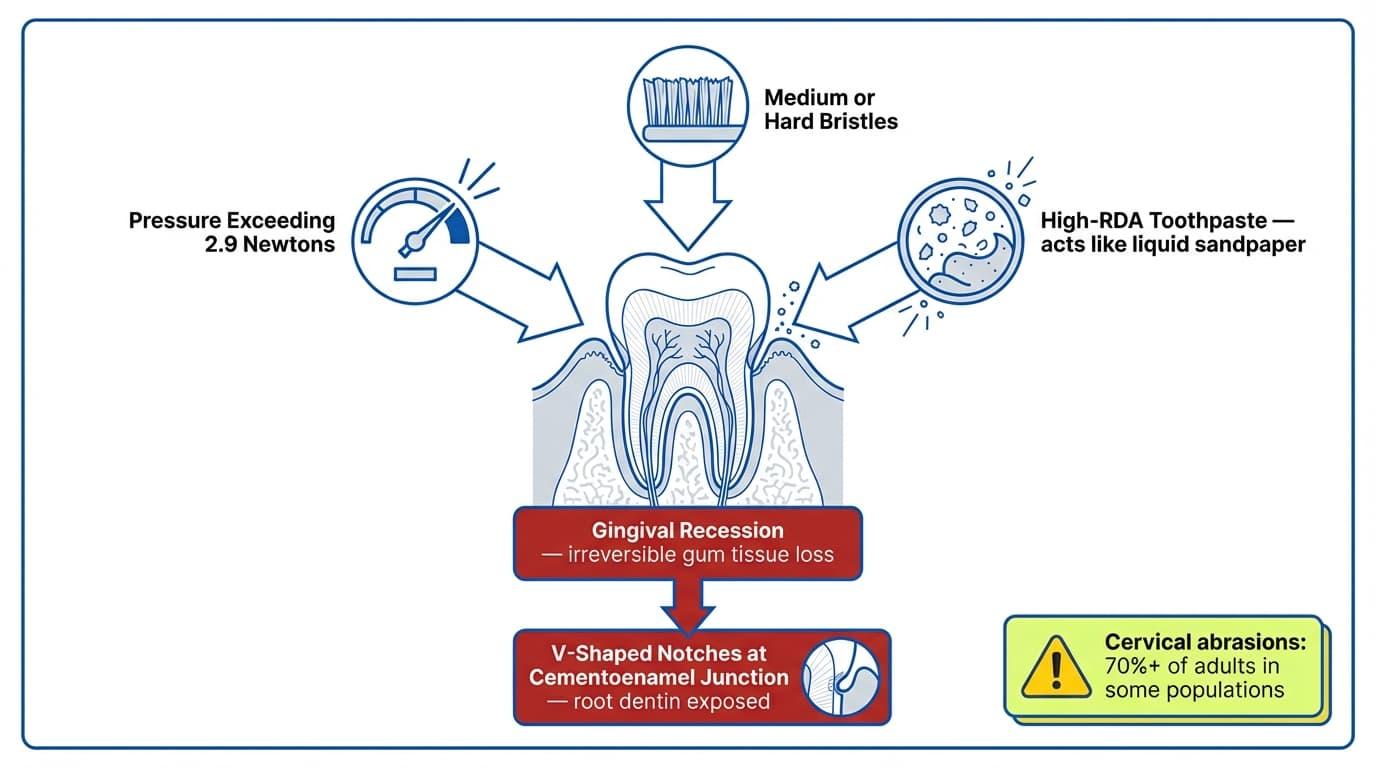
The risk is not the electricity. It is the combination of too much pressure, abrasive products, and time.
Excessive force is the primary culprit
Excessive mechanical force is the primary catalyst for electric toothbrush-induced dental injuries.
When a user applies brushing pressure exceeding 2.9 Newtons, the aggressive bristle friction begins stripping the protective gum tissue, leading to irreversible gingival recession. Concurrently, this high-pressure friction concentrated at the cementoenamel junction creates non-carious cervical lesions—distinct, V-shaped notches worn directly into the tooth's root.
Once the root dentin is exposed through these lesions, patients experience chronic hypersensitivity to thermal changes and require clinical intervention, such as composite bonding or gum grafting, to repair the structural deficit.
How common is this? Studies published in the Journal of Clinical Periodontology suggest cervical abrasions affect more than 70% of adults in some populations. Gum recession was present in approximately 41% of participants in one study of 710 subjects.
Early warning signs to watch for:
-
V-shaped grooves or notches at the neck of teeth, especially canines and premolars
-
Visible root surfaces that look yellower than the crown
-
Sharp sensitivity to cold air, water, or sweet foods
-
Teeth that appear longer because the gum has pulled back
The Multiplier Effect
The physical stiffness of the brush head is a critical factor in enamel preservation. Utilizing medium or hard bristles on an electric toothbrush acts as a destructive mechanical abrasive, carving microscratches directly into the enamel surface and inducing microtears along the delicate gum margin, regardless of the brushing pressure applied.
Furthermore, integrating a highly abrasive toothpaste neutralizes the safety benefits of built-in pressure sensors. When a high-RDA (Relative Dentin Abrasivity) paste is agitated by a 30,000-stroke-per-minute sonic motor, it functions like a liquid sandpaper, rapidly accelerating the thinning of the enamel laye
How Brush Type, Force, and Toothpaste Together Affect Enamel
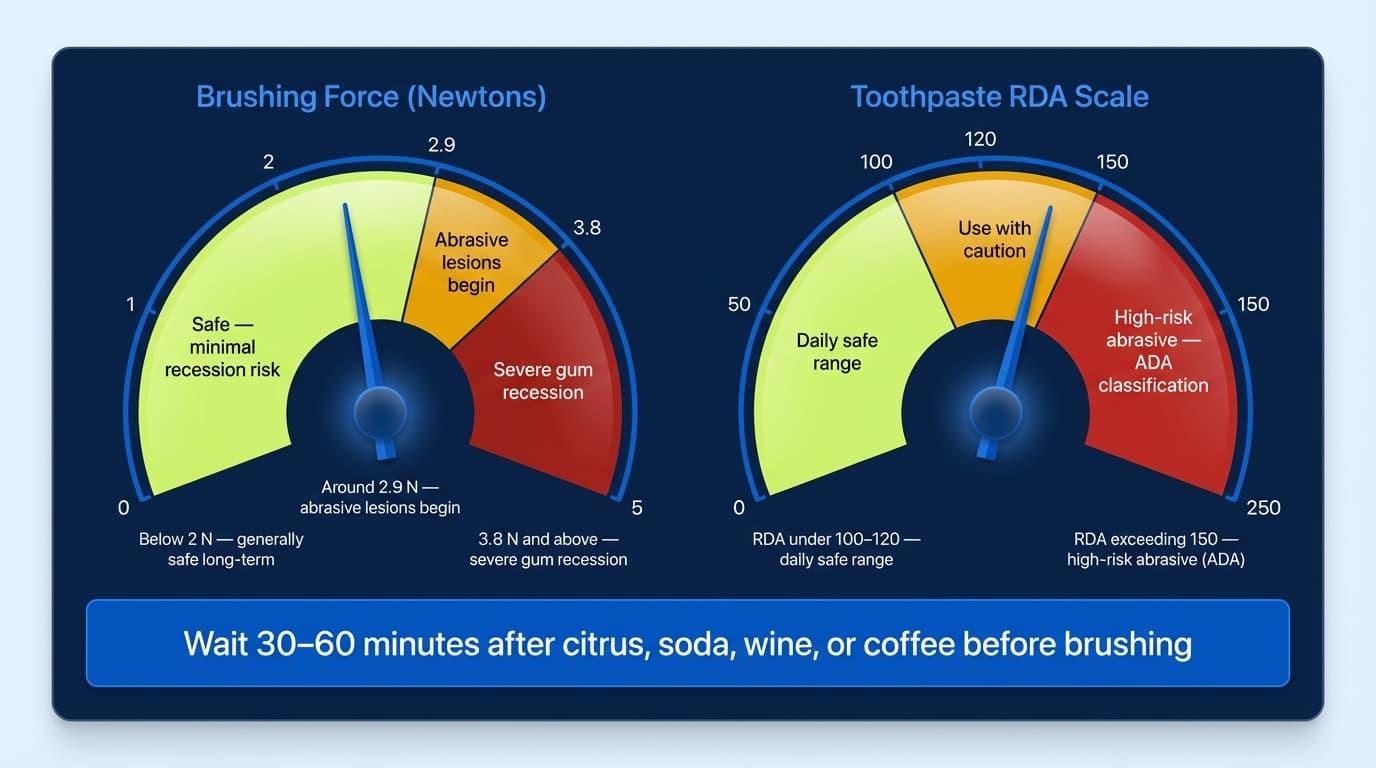
Brush type is only one piece of the puzzle. Force and what is on the bristles, meaning your toothpaste, matter just as much.

Toothpaste abrasivity is a hidden variable
The American Dental Association (ADA) rates commercial toothpastes using the Relative Dentin Abrasivity (RDA) scale, classifying any formula with a value exceeding 150 as a high-risk abrasive capable of damaging enamel.
When combined with an electric brush and aggressive brushing habits, a high-RDA toothpaste can accelerate wear on already-thin enamel. Many whitening toothpastes fall into this high-RDA category.
Timing matters too
Acidic foods and drinks, such as citrus, soda, wine, and coffee, temporarily soften enamel. Brushing within 30 to 60 minutes of acid exposure, especially with a powerful sonic brush, can remove more tooth structure than brushing on fully hardened enamel. The simple fix: wait before you brush.
The SNOW Toothpaste is formulated with hydroxyapatite to help support your enamel as part of your daily oral care routine. It uses a low-abrasivity formula designed to be gentle on teeth while still supporting a brighter appearance. It pairs well with any electric toothbrush for a routine that cleans without compromising your tooth structure.
Get the SNOW Toothpaste with Hydroxyapatite Today
Who Is Most at Risk of Damage From Electric Toothbrushes?
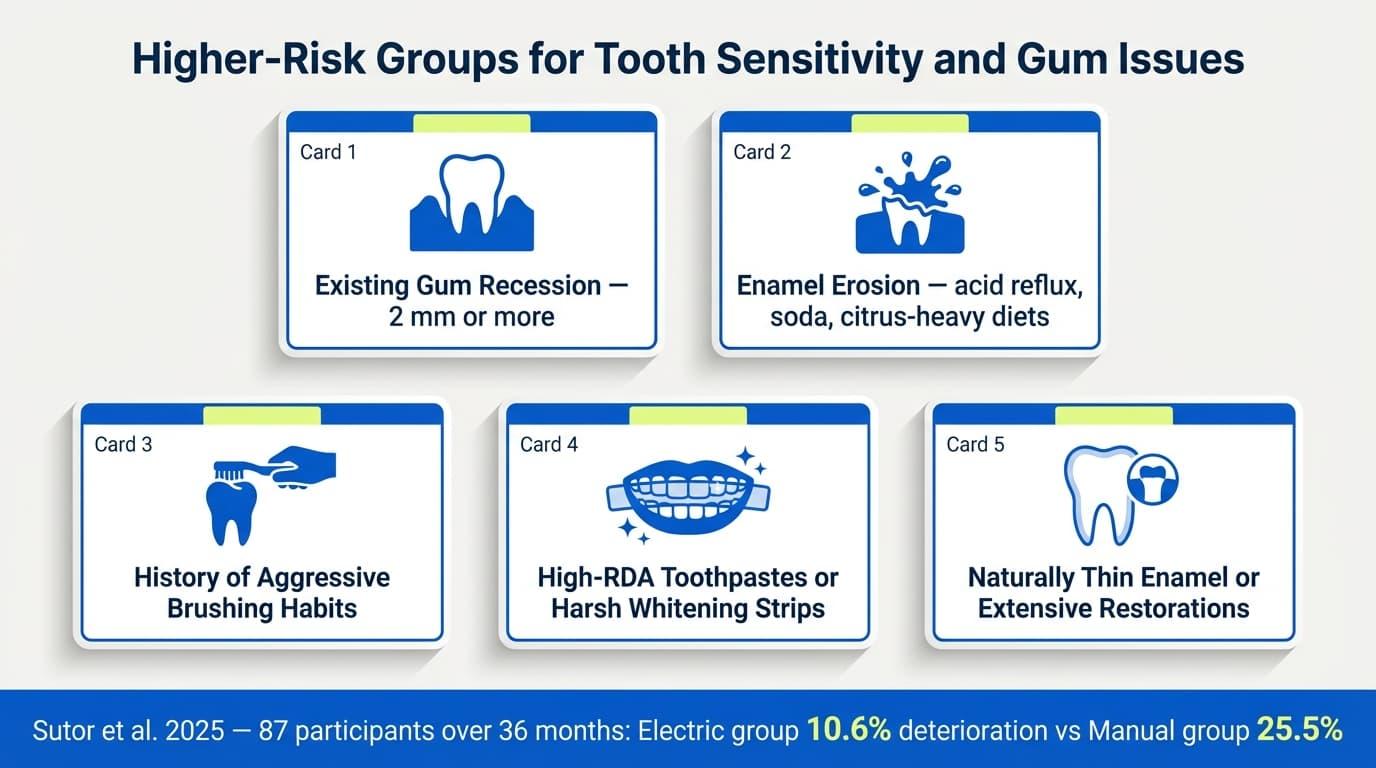
We know that not every mouth tolerates the same level of mechanical stress. Some people face a higher risk than others.
Higher-risk groups include:
-
People with existing gum recession of 2 mm or more
-
Those with enamel erosion from acid reflux, frequent soda consumption, or citrus-heavy diets
-
Anyone with a history of aggressive brushing habits
-
People using harsh whitening strips or high-RDA toothpastes regularly
-
Those with naturally thin enamel or extensive dental restorations
Interestingly, a 2025 randomized controlled trial by Sutor et al. followed 87 participants with pre-existing gum recession of 2 mm or more over 36 months. Electric toothbrush users showed a slight improvement in recession on average, while manual brush users saw a slight worsening. Fewer teeth deteriorated by 1 mm or more in the electric group (10.6%) than in the manual group (25.5%).
What we have found is that when used correctly, an electric toothbrush can actually be protective for at-risk patients, not harmful.
If you are noticing yellowish root exposure, sharp sensitivity to cold air or water, or your gumline seems to be changing shape, talk to a dentist before making any changes on your own. Your specific risk profile matters more than any generic advice.
Safe Electric Toothbrush Technique (Step-By-Step)
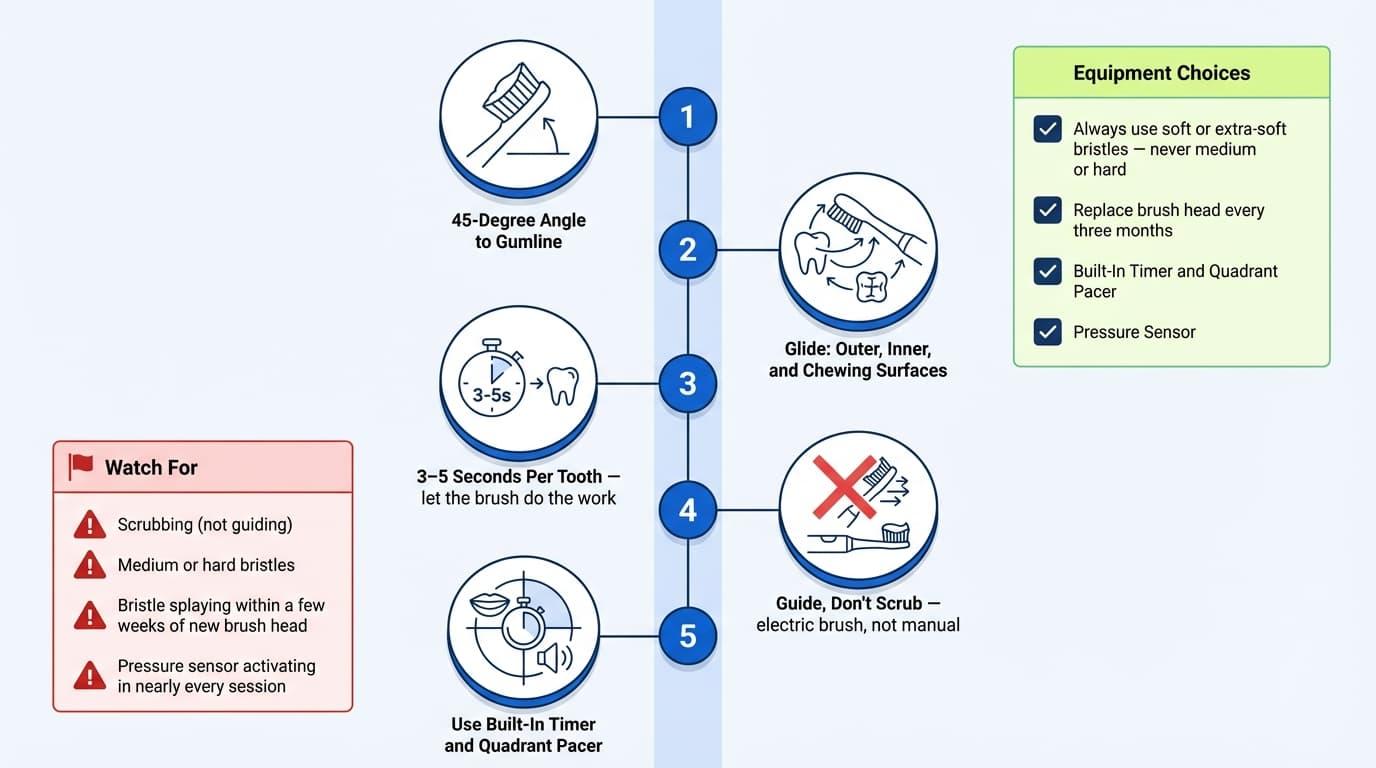
What we have found is that technique matters more than price, speed, or brand. Here is how to use your electric toothbrush properly.
How To Apply The Right Pressure
Aim for gentle pressure, think of it as the pressure you would use to write with a pen rather than scrub a stain. If your bristles are flaring outward, you are pressing too hard. If your pressure sensor activates frequently, that is your signal to ease up.
Your two-minute brushing routine:
-
Hold the brush head at a 45-degree angle to your gumline
-
Glide slowly along each tooth's outer surface, inner surface, and chewing surface
-
Spend about 3 to 5 seconds per tooth and let the brush head do the work
-
Do not scrub back and forth. With an electric toothbrush, your job is to guide, not push
-
Use the built-in timers and quadrant pacer for even coverage across your whole mouth
Equipment choices that protect your enamel:
-
Always use soft or extra-soft bristles. Never medium or hard.
-
Replace the brush head every three months or sooner if the bristles fray
-
Choose models with pressure sensors and keep them enabled
-
Use sensitive mode if your gums feel tender or look red after brushing
Red flags to watch for:
-
Gums that bleed persistently after gentle brushing
-
Visible bristle splaying within just a few weeks of using a new brush head
-
The pressure sensor is activating in nearly every session
-
Increasing gum irritation despite a gentle technique
SNOW Replacement Brush Heads feature soft bristles to help protect teeth and gums during daily brushing. Replacing your brush head every 3 months is one of the simplest ways to maintain proper technique and keep your oral hygiene routine effective. They are compatible with the SNOW Electric Toothbrush.
Get SNOW Replacement Brush Heads
How to Protect and Support Your Enamel Beyond the Brush
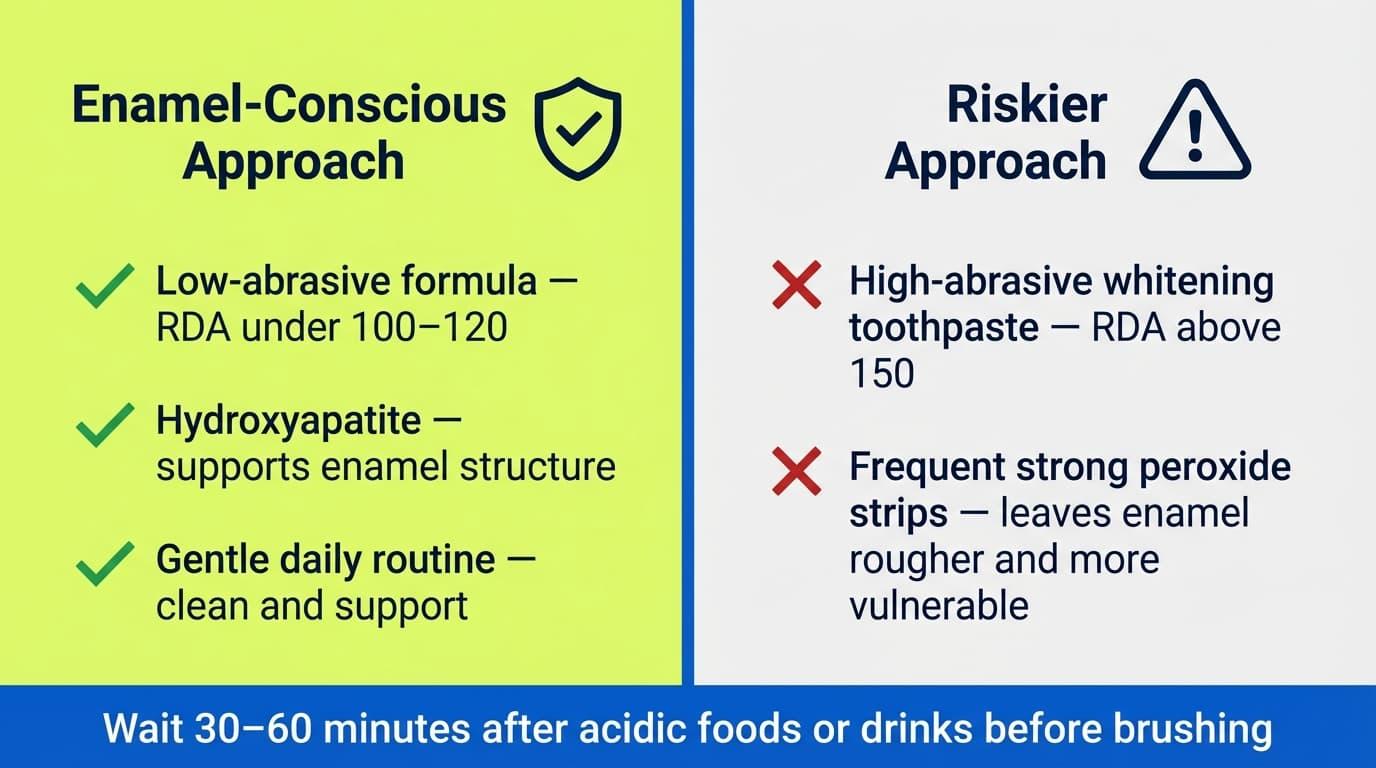
The key question here is not just whether your brush is safe. It is what you are doing every day to take care of your enamel.
How Enamel Support Works
Your saliva naturally contains calcium and phosphate ions that help with microscopic repair at the enamel surface. Certain oral care ingredients, particularly hydroxyapatite, may help support this process by depositing minerals into the enamel structure.
Whitening Approaches and Enamel Safety
Enamel-conscious approaches: low-abrasive formulas with enamel-supportive ingredients like hydroxyapatite are designed to support a brighter appearance while being gentle on teeth
Riskier approaches: highly abrasive whitening toothpastes with an RDA above 150 and frequent use of strong peroxide strips can leave teeth feeling rougher and more vulnerable to future wear
Practical daily guidelines:
-
Choose toothpastes with low to moderate RDA values, ideally under 100 to 120 for daily use
-
Look for enamel-supportive ingredients that complement your brushing routine
-
Wait 30 to 60 minutes after acidic foods or drinks before brushing
-
Think of your routine as a clean and support system, not just stain removal
When your electric toothbrush removes plaque effectively, and your toothpaste is formulated to support enamel, you are working both sides of the equation every single day.
Choosing the Right Electric Toothbrush for Enamel-Conscious Users
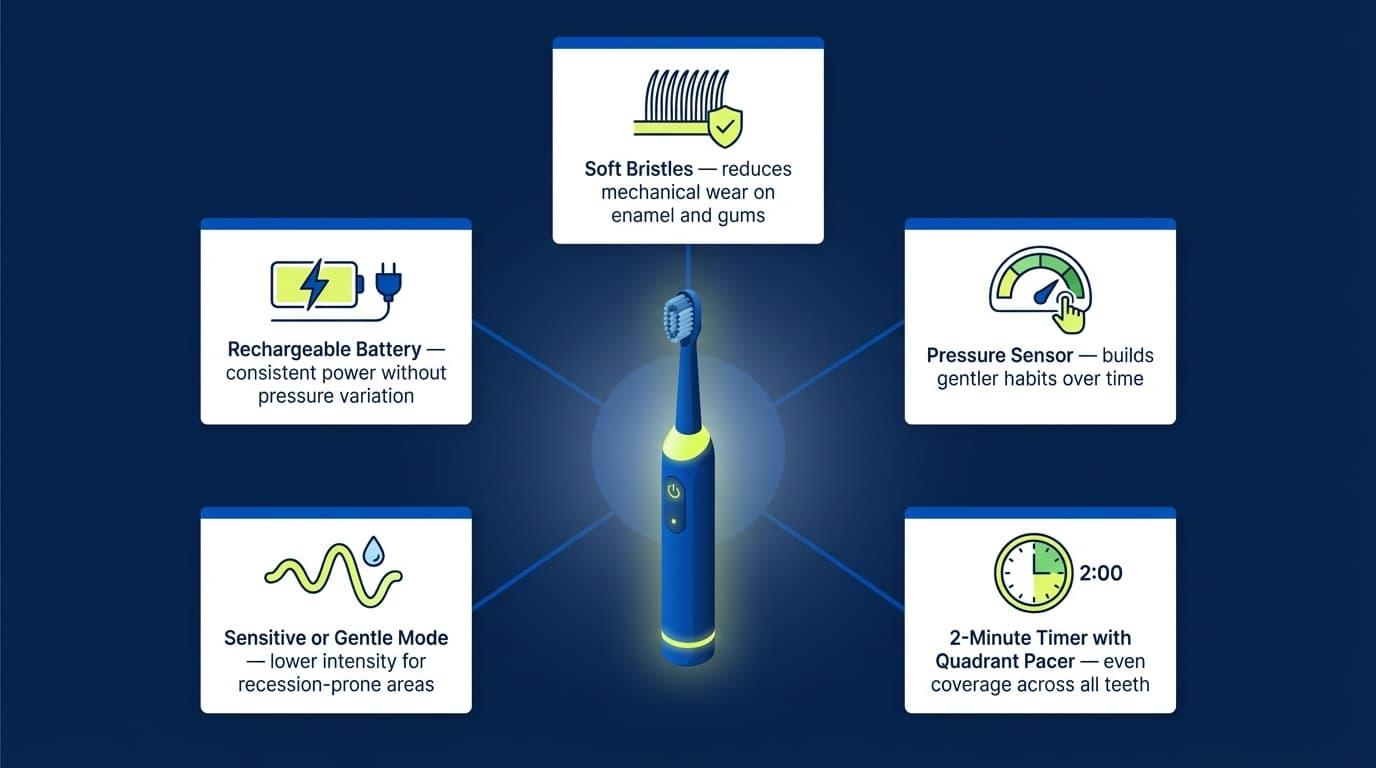
Most mainstream brands offer multiple models, and the enamel safety of any electric toothbrush depends on choosing the right features for your mouth. Here is what to look for.

When You Should See a Dentist About Electric Toothbrush Damage
Most sensitivity or soreness can be improved by adjusting your technique and products. But some signs need professional attention.
Red-flag symptoms that need a dentist:
-
Sudden sharp sensitivity in one specific tooth
-
Visible notches or grooves at the gumline
-
The gumline visibly pulls away over weeks or months
-
Cracks or chips that were not there before
-
Persistent bleeding despite gentle brushing
-
Possible signs of gum disease, such as persistent redness or swelling
Long-term overbrushing can progress to chronic sensitivity, root exposure, and, in severe cases, the need for more complex dental treatment.
Practical tip: Bring your toothbrush and toothpaste to your next dentistry appointment. Your dentist or hygienist can give specific feedback on whether your pressure habits, bristle type, or product choices may be contributing to any issues.
Final Thoughts
Electric toothbrushes are not the enemy of oral health. Used correctly, with gentle pressure, soft bristles, and the right toothpaste, they are one of the best tools available for effective daily brushing and long-term dental health.
What we have found is that the people who get the best results are the ones who pair a good brushing technique with products that support their enamel, not work against it. That combination is what protects your teeth and gums for years to come.
If you are ready to build a safer, smarter brushing routine, SNOW has everything you need.
From the SNOW Electric Toothbrush to enamel-supportive toothpaste and gentle whitening options, SNOW is used by millions of people who want results without compromising their dental health. Every product is designed to work together as part of a thoughtful, daily oral care routine.
Explore the full SNOW Oral Care Range
FAQs
A lot of people ask us these questions before making changes to their routine. Here are the straightforward answers.
Can switching back to a manual toothbrush reverse the damage from my electric brush?
Switching to a manual toothbrush can reduce mechanical intensity if it helps you use less force, but it does not reverse existing enamel loss or gum recession. What helps most is a gentler technique, soft bristles, and enamel-supportive toothpaste, regardless of brush type. Keep in mind that some people actually press harder with a manual brush, so switching is not automatically safer without a conscious change in brushing habits.
How can I tell if my electric toothbrush is too abrasive for my teeth?
Watch for early warning signs over the first few weeks: increasing cold sensitivity, sore gums after brushing, or bristles that fray in less than a month. Try a simple test after brushing. Your teeth should feel smooth, not rough or etched, and your gums should not sting or bleed consistently. If symptoms appear, a dentist can check for micro-abrasions and recommend a softer brush head or a gentler mode.
Is it safe for kids and teens to use electric toothbrushes without damaging their enamel?
Electric toothbrushes can be safe and effective for children, generally from around age three to six, when used on a gentle setting with soft bristles and under parental supervision. Parents should teach kids not to scrub with the brush and watch for signs of overbrushing at the gumline.
Electric toothbrushes are clinically safe for children aged 3 and older, provided the device is equipped with a pediatric-sized, ultra-soft brush head.
The American Academy of Pediatric Dentistry (AAPD) recommends locking the brush to its lowest oscillation setting and utilizing supervised, app-guided 2-minute timers to prevent aggressive manual scrubbing habits from forming.
Does brushing longer than two minutes with an electric toothbrush increase damage risk?
Consistently brushing for more than 2 minutes, especially with high-pressure and abrasive toothpaste, can increase cumulative wear over the years. Going slightly over, like 2.5 to 3 minutes at very gentle pressure, is generally fine. But aggressively brushing for 4 to 5 minutes twice daily is not a good idea. Stick to the built-in timers and focus on thorough, even coverage rather than extra time for the best results.
Should I stop whitening my teeth if I’m worried about enamel damage from brushing?
Not all whitening approaches carry the same risk. Highly abrasive whitening pastes and frequent, strong peroxide strips can contribute to mechanical wear from daily brushing. What we have found works better is shifting toward low-abrasive, enamel-conscious whitening options that include supportive ingredients like hydroxyapatite rather than relying on grit or harsh oxidizers. If you have existing sensitivity or recession, talk to your dentist before starting or changing any whitening routine, especially if you use a powerful electric toothbrush daily.


